
Investor Readiness
Fund administration explained: Behind the scenes of VCs
What Is Fund Administration All About? Johanna von Herman explains the basics of professional fund administration, common pain points, efficient reporting, regulatory requirements, and career paths in the field of VC fund administration.
07.10.2025
Alina Nauen, Johanna von Herman
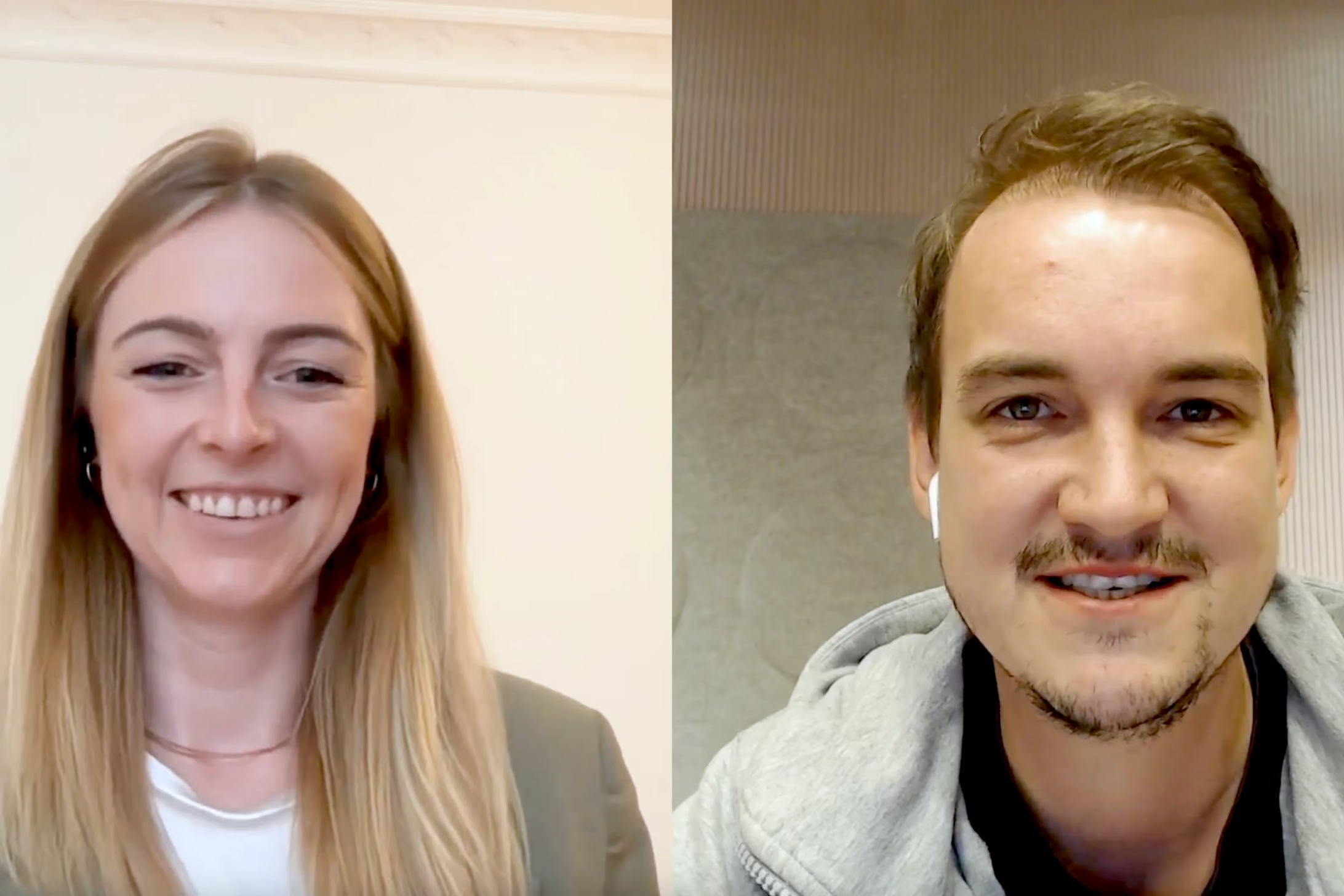
This interview is based on an episode of the torq.partners Finance Podcast featuring guest Johanna von Herman, a fund administration expert and business angel. The full episode is available on Spotify and YouTube as a video podcast.
What exactly does fund administration do?
Fund administration ensures that a fund operates like a business: it requires accurate accounting, documented cash flows, and reliable reporting. Investors want to understand how their capital is being used. In addition, there are capital calls that must be managed professionally, as well as extensive regulatory reporting to BaFin and the Bundesbank. Another key aspect is tax compliance—ranging from tax returns for the fund to profit and loss statements for the LPs (Limited Partners).
Why is fund administration often considered a pain point?
Everyone knows it’s necessary, but no one wants to spend much of their budget on it. When technology is lacking, many manual steps are required, especially in Excel. Numerous interfaces, manual data transfers, and formatting issues increase the likelihood of errors—and those errors end up in the reports.
What are some typical inefficiencies that you address?
Capital calls are often calculated in Excel, then transferred to Word documents and sent out as form letters. Thirty-page quarterly reports must be prepared according to a standardized format; data from portfolio companies must be collected, and valuations must be performed accurately. Without technology, this can take weeks.
What does the reporting chain between the fund and the portfolio companies look like—and why are there problems there?
Many young portfolio companies have limited resources and report in a variety of formats. This makes consolidation and valuation difficult. Standardized templates help, but companies in a strong position sometimes turn the tables and impose their own format—and funds need to be able to handle that.
How are venture capital funds typically structured?
In the early stages, the structure is often lean: a management company, an appointed general partner (GP), and often a carry vehicle. Later on, it becomes more complex—with multiple fund entities under one management company and additional special purpose vehicles (SPVs) for specific investments.
Who plays what role in the fund—and why are there still so few female GPs?
Typically, one to three GPs found a firm and initially handle sourcing as well. As the firm grows, investment managers, analysts, and often a (fractional) CFO join the team. Female GPs are still rare—many don’t feel confident taking the plunge due to work-life balance concerns, and the role is less visible. Greater awareness and role models are intended to change that.
Where do the interests of GPs and LPs clash—and how does a fund perform over time?
LPs expect as much capital as possible to flow into investments rather than into overhead. At the same time, they place a great deal of trust in the GPs but have no say in individual decisions. VC funds are closed-end vehicles with typical terms of ten years plus extension options; capital is called down through capital calls. It is rarely possible to exit via secondaries.
How does the weak exit environment affect things—and what solutions are available?
When exits fail to materialize, funds are increasingly turning to continuation funds. Maturing assets are transferred to a continuation fund, which continues to operate without a fixed term until a viable exit is possible.
How do you get started in fund administration—and what kinds of roles are involved?
People often get their start through on-the-job training. The roles require, among other things, fund accounting skills, in-depth knowledge of regulations for compliance, ESG expertise, and tax advisory skills. Those who want to work with a wide range of funds and have a broad scope of responsibilities are well-suited for a managed service or advisory role; those who want to focus on a single fund should move to the GP side.
How did you become a business angel—and what criteria do you use when investing?
My journey began with an early interest in capital markets, later shifted toward venture capital, and eventually led to a desire to work more closely with startups. In terms of focus areas, education/lifelong learning and food tech/food safety are personally important to me. In the very early stages, the key factors are the team, product maturity, go-to-market strategy, and whether the team can truly get the business off the ground.
Are there any clear "no-gos" in a pitch—and what advice do you give to founders?
An unstructured or missing business plan is a deal-breaker. Pitch decks with spelling errors are immediately rejected. I also recommend that female founders take the plunge, actively seize opportunities, and embrace risk—data showing lower failure rates for women-led companies also improves fundraising prospects.
Contents
Interim Support
Does your finance team need help?
Book a no-obligation initial consultation now.
Schedule a meeting
free download
Guide – OSS and Sales Tax Explained Simply
Cross-border sales to individual customers in the EU entail certain tax obligations. Our concise OSS Guide provides you with the most important information and deadlines.
Download →

podcast
Startup Funding 2025: The VC Market, Strategies, and Challenges with Kolja Heskamp
The VC Market Landscape in 2025, Fundraising Strategies, Profitability vs. Storytelling, and Investor Readiness.
Listen on Spotify →
More Articles



Investor Readiness
Startup Funding 2025: VC market, strategies and challenges
2025 is off to a strong start in the fundraising market. Despite the shift in interest rates, there is a greater willingness to take risks—especially in deep tech and AI. In this interview: trends, valuation logic, and strategies for founders.
26.08.2025