Employee Interview
Professional development and social commitment
Charlotta, who has been part of the team since torq.partners was founded, shares her thoughts on the company's development.
10.03.2025
Lena Hocker
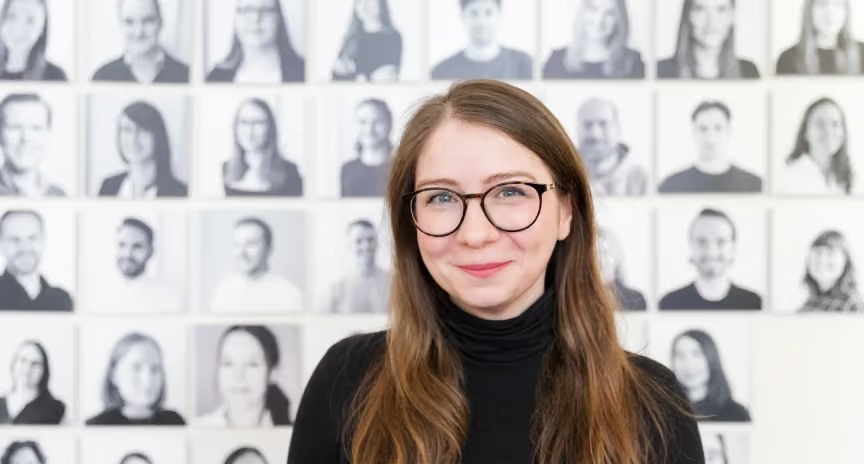
What changes do you experience when you accompany an organization from the very beginning? Charlotta Frings, who has been part of the team since November 2020, the year torq.partners was founded, shares her impressions of the company's developments in this interview. She also gives an insight into her professional career and talks about how she is involved in an internal working group for the empowerment of women in addition to her position-related tasks.
Charlotta, what is your role at torq.partners and what tasks does it involve?
I am a manager in the Generalist Track at torq.finance and currently focus primarily on interim assignments. In my interim roles, my main responsibilities include overseeing the entire management accounting function and providing guidance to team members responsible for operational tasks. In addition, I coordinate the monthly closing processes and, during the monthly closing period, am responsible for resolving open issues, preparing the final reports, and subsequently discussing them with our clients. This phase is always particularly intense for me due to the many tasks involved and the time pressure.
What was your professional career like and how did you come across torq.partners?
Before joining torq.partners, I worked at two different startups. Unfortunately, one of them had to shut down, and the other had to downsize its workforce. When it became clear that my employer at the time would have to let me go, I spoke with my tax advisor at the time about the challenges I had repeatedly faced in my work in the startup world. I was often left to my own devices. It also bothered me that, while I was always able to complete all my tasks, I was never sure if I was doing them in the best way possible. That’s why, when looking for a new job, it was important to me to work with true professionals so I could learn how to do things right. I no longer wanted to just put out fires; I wanted to grow professionally. My tax advisor then advised me to pursue a role at a management consulting firm, since I’d experience a steep learning curve there and work as part of a team. Through him, I came into contact with two of the managing partners at torq.partners. At that point, the company had been founded just two months earlier. During my conversation with the two partners, I immediately felt that the company offered exactly what I was looking for.
Do you usually work from home or in one of our offices?
I work almost exclusively from home, which has both advantages and disadvantages. On the one hand, I find it super practical as I don't have to travel and can cook my lunch at home. On the other hand, I see it as a challenge for the working atmosphere. Sometimes I miss the direct contact with my colleagues. Overall, I still think it's great that we have a remote-first culture, as I appreciate the flexibility of being able to work from other locations. Besides, I always have the option of going into the office after all.
What measures make it easier for you to have a good exchange even when working from home?
In my team, we have check-ins twice a week, during which our manager shares important information but also creates space for professional discussions and personal conversations. Otherwise, I try to attend all team events and occasionally meet up with colleagues in the office. Last year, for example, I suggested that we meet for breakfast together in one of our project teams. I thought that was great. After completing a leadership training course, I became even more aware of how important these moments are for team cohesion. It shouldn’t always be just about work—it’s also about celebrating successes together and talking about other topics. I brought that idea right back to the team, and I think it was well-received by everyone.
In what ways has torq.partners developed the most since you started?
That’s hard to say because so much has changed. Last year marked my four-year anniversary at torq.partners. To mark the occasion, I thought a lot about what it was like when I first started: We had just over ten employees and could still hold our weekly team meeting with everyone together. So the biggest change is probably the company’s tremendous growth. Back then, I knew exactly which projects everyone was working on; today, a lot of it goes right over my head. That’s obviously a good sign of the company’s growth, but it also brings with it more anonymity. Since I started during the height of the COVID-19 pandemic, another positive development for me was that team events could finally take place in person again after the pandemic. They make it possible to connect with people you don’t interact with directly in your day-to-day work, thereby helping to minimize the risk of increasing anonymity.
How was your personal development at torq.partners?
I started as a junior consultant, which today corresponds to the position of senior associate. In that role, I mainly provided support and didn’t yet have much responsibility of my own. However, I made it clear from the start that my goal was to work my way up to the consultant position. Together with my supervisor at the time, I defined what would be necessary to achieve that, and over time I took on the appropriate projects. This allowed me to prove that I could handle all the necessary tasks, and I was eventually promoted to the role of Consultant. This year, I took another step forward and am now a Manager. In my new position, the work is more challenging. I also have significantly more responsibility than when I started. Last year, for example, I led a project independently for the first time, and I’m now also the People Lead for one person.
In your opinion, what are the qualities that are most important for your role and why?
A certain degree of self-organization is important, since we work on various engagements and, as a result, regularly have to adapt to new work environments. Equally important is the ability to set boundaries—that is, to recognize that while you’re working on an engagement, you’re not responsible for every task that arises from it, nor do you have to be available around the clock. This helps prevent burnout even when the workload is high. Another important quality is strong communication skills. I notice time and again that at least 85 percent of the problems that arise can be traced back to a lack of communication. That’s why I encourage our team to communicate actively: Please provide regular updates so that everyone knows where things stand and our clients always feel well taken care of.
What has been the biggest challenge for you in your work so far?
Of course, there are always assignments where not everything goes smoothly. The biggest challenge for me, however, was that—due to the company’s growth and the resulting restructuring—I had several different supervisors over the course of two and a half years. As a result, I often had to adjust to new structures and ways of working. This experience has once again made me realize just how crucial good leadership is—especially now that I’m taking on leadership responsibilities myself. Throughout my career, I’ve encountered both inspiring and demotivating leadership styles, and I’ve seen firsthand the impact a single conversation can have. As a leader, it’s important to me to ensure that my colleagues feel seen and valued.
If you had the opportunity to work in a different position or department at torq.partners for a day, which one would you choose and why?
I would like to get to know the daily routine in our HR consultancy torq.people, especially in interim positions. In my own role, I sometimes realize that it can be time-consuming to enter established structures as an external person. In finance, this only causes problems to a limited extent, as you work independently here to a large extent anyway. In HR, on the other hand, a lot of exchange is required. I am therefore interested in how my colleagues at torq.people manage to position themselves accordingly within companies and achieve sustainable results in interim roles.
Are you active in other projects or initiatives at torq.partners in addition to your position-related tasks?
Yes, I’m part of a working group on women’s issues at torq.partners. The group’s central focus is the fact that—at least on a societal level—gender equality does not yet exist, even though it is enshrined in our Constitution. The finance sector, in particular, remains a male-dominated field, especially in leadership positions. Through our work, we aim to empower one another and advance women in general. It’s important to me to emphasize that our goal is not to exclude men or position ourselves against them. Quite the contrary: we won’t bring about change if we don’t bring men along with us on this journey. We must make it clear to everyone, regardless of gender, how important this issue is, and emphasize that true equality benefits us as a society as a whole. One of the essential steps on the path to equality is to critically examine ourselves. Many people say they treat everyone equally, but is that really the case? Don’t we still harbor certain biases? This is an area where I’m very involved. Another focus of our work is on women’s financial independence and how they can build wealth in a targeted way. Our working group has already organized a dinner where female colleagues from our team shared their experiences on this topic. Just recently, we also co-hosted the “Invest like a Woman” networking event with N26, which was attended by many of our female clients.
What values do torq.partners represent for you?
For me, one of the most important values is commitment—both in relation to our clients and internally. Contrary to the usual stereotypes about management consulting firms, we at torq.partners are dedicated to bringing about real change and developing sustainable, constructive solutions. Internally, what matters most to me is our commitment to one another: there’s a great deal of support, and if you have any questions, you can always find someone who’s already dealt with the issue. This has allowed me to learn an incredible amount.
Which of our team events do you remember particularly well?
I actually think all our team events are always pretty successful. I particularly liked the first offsite in 2023, as we had a lot of room for individual organization and were able to have real encounters with our colleagues. I also really enjoyed our first summer party in 2021, when we hired a boat and spent a relaxing evening on the water together.
Contents
Interim Support
Does your finance team need help?
Book a no-obligation initial consultation now.
Schedule a meeting
free download
Template - Create Expense Reports in Minutes
Standardize the expense reimbursement process to get a clear overview of the expenses for which employees make advance payments.
Download →
podcast
Sustainability in business: ESG and finance with Theresa Zöckler from Code Gaia
ESG following the Omnibus Resolution, decarbonization as a management tool, and materiality analysis.
Listen on Spotify →
More Articles
Finance
Setting Up Interim Finance the Right Way: Freelancers vs. Execution Partners
What is the difference between freelancers and an execution partner like torq.partners? We explain which interim finance setup makes sense in which situation and what factors are important when making that decision.
12.01.2026